
Industrial welding preheat can become complicated quickly.
Heating a small section of material with one or two strip heaters is relatively straightforward. But when a project grows to include large weld areas, heavy steel sections, or numerous heating points operating simultaneously, the electrical system supporting those heaters becomes just as important as the heaters themselves.
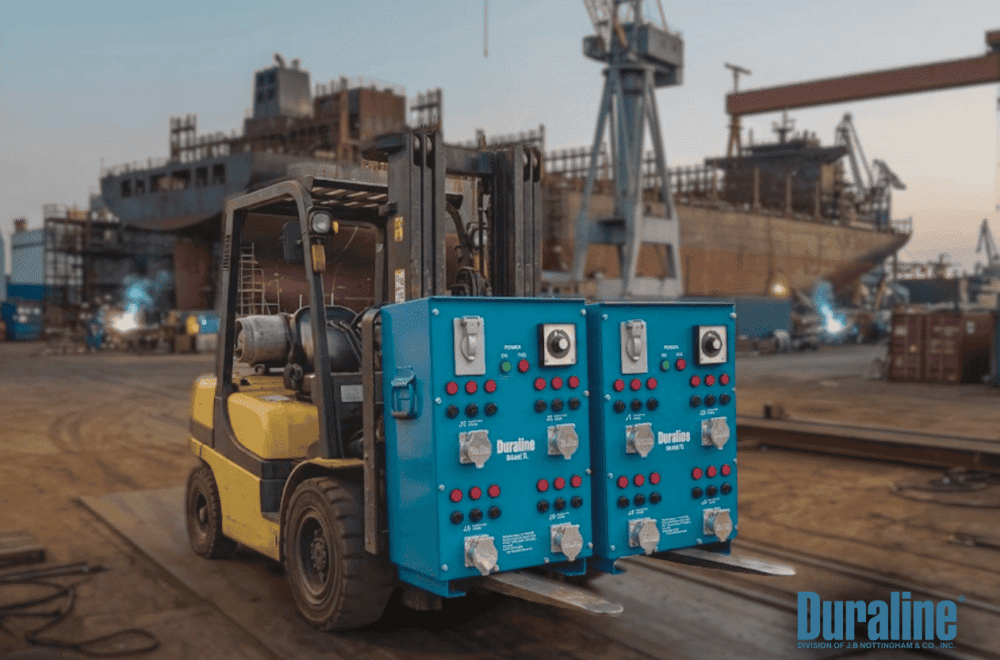
Duraline’s Mini PreHeat Treating System approaches that challenge by creating a centralized, portable control point for a larger network of electrical resistance strip heaters.
Rather than treating every heater as an independent piece of equipment, the system brings power distribution and heat-cycle control together into an expandable heating network.
Why Preheating Matters Before Welding
Depending on the base material and service conditions, welding procedures may require preheating, post-weld heating, or stress-relief treatment to achieve the desired weld integrity.
Preheating can help reduce thermal shock, decrease the cooling rate of the weld area, and remove moisture—all of which can help reduce conditions that contribute to cracking. Duraline’s heating systems are designed for applications involving material sections ranging from approximately 1/2 inch through 7 inches thick.
The challenge becomes delivering that heat consistently when the area being treated requires many heaters rather than just one.
From Individual Strip Heaters to a Heating Network
A large preheat operation may require strip heaters positioned across multiple sections of the workpiece.
Duraline offers non-thermostatic strip heater assemblies in several sizes and outputs, including configurations ranging from smaller 12-inch heaters through larger 36-inch assemblies. The heaters shown in the Mini PreHeat family use 460V heating elements with 14/3 SOOW cable assemblies.
Instead of powering and managing those heaters as unrelated devices, the Mini PreHeat system provides the infrastructure needed to organize them into a larger system.
This is where centralized control becomes particularly valuable.
One Portable Panel Can Support a Large Heater System
At the center of the system is Duraline’s P114601-HP Mini PreHeat Heater Control Panel.
The panel uses a 100-amp, three-phase, three-pole/four-wire input and provides four Duraline 4RJ20 three-pole/four-wire output receptacles. Depending on the configuration, Duraline states that the system can support up to 80 heaters. Heater voltage is 480 volts.
That changes the role of the panel considerably.
Rather than simply providing an electrical connection for a heater, it becomes the central power and control point feeding an expandable network of heating equipment.
For large fabrication or welding operations, that provides a much more organized approach to building a preheat system around the work.
Percentage Control Makes Heat Adjustable to the Application
Centralization isn’t useful if the operator cannot adjust how the heaters behave.
The Mini PreHeat panel incorporates a percentage timer that controls heating time, allowing the heating cycle to be calibrated according to the requirements of the application.
Instead of relying only on the individual heater’s output, operators can control the percentage of time that power is being supplied.
That provides a straightforward method of adjusting the amount of heat being introduced into the workpiece while keeping control centralized at the panel.
The result is an electrical resistance heating system that can be configured around different welding and heat-treatment requirements.
Power Streamers Extend the System to the Work
The control panel is only the beginning of the network.
Duraline’s Mini Strip Heater Power Streamers distribute power from the central system toward individual heater locations. One current configuration uses 62.5 feet of 12/4 SOOW cable, with six taps spaced along the assembly. Each tap then incorporates a six-foot heater cord terminating in a female connector.
That arrangement allows the central panel to remain in a practical operating location while power is distributed closer to the sections requiring heat.
Additional heater assemblies can then be positioned where the welding procedure requires them.
Conceptually, the system becomes:
Control Panel → Power Streamers → Heater Connections → Strip Heaters → Workpiece
That is much easier to expand and organize than treating dozens of heating elements as completely separate electrical systems.
Centralized Doesn’t Mean Stationary
One of the important advantages of the Mini PreHeat concept is that centralized control does not require building permanent heating infrastructure around every welding location.
The system is portable.
That matters in industries where the work moves rather than remaining on a fixed production line. Shipbuilding and repair, structural fabrication, industrial maintenance, construction, and heavy manufacturing can all involve welding projects in different locations.
The panel and its associated distribution equipment can be deployed around the job rather than requiring every work area to have its own permanent preheat infrastructure.
Once the work is completed, the equipment can be moved and configured around the next application.
Scaling the System Around the Job
Not every welding project requires 80 heaters.
And that’s part of the advantage.
Duraline describes its welding preheat equipment as adaptable to jobs of different sizes and configurations. A smaller operation can use the heating equipment it actually requires, while a substantially larger application can expand the network with additional distribution and heater assemblies.
That means the same basic approach can support different project requirements without forcing every job into one fixed heating layout.
For facilities performing a variety of welding work, this scalability can be particularly useful.
Centralized Control Can Simplify Large Preheat Operations
Consider the alternative when dozens of heaters are required across a large welding operation.
Every heater needs power. That power has to reach the work area. Connections have to be organized, and operators need a practical way to manage the heating process.
As the number of individual components grows, organization becomes increasingly important.
A centralized system creates a more deliberate hierarchy:
one control point feeding organized distribution, which then supplies the heater network.
That doesn’t eliminate the need for proper welding procedures, temperature measurement, qualified personnel, or appropriate inspection. What it does is provide electrical infrastructure specifically designed to support a large resistance-heating operation.
Designed as a Reusable Industrial System
Temporary doesn’t have to mean disposable.
Duraline specifically identifies long service life and complete reusability among the benefits of its welding preheat systems.
That distinction matters for facilities performing preheat work regularly.
Instead of assembling a new collection of unrelated heating components every time a project requires preheating, a reusable control, distribution, and heater system can become part of the facility’s welding equipment inventory.
When another project arrives, the system can be configured again around the new work.
Modernizing Preheat Through Better Organization
Modernizing an industrial process doesn’t always require replacing the underlying technology.
Electrical resistance heating remains a practical method of applying controlled heat for welding preheat, post-heat, and stress-relief applications. The opportunity for improvement is often in how that heating equipment is powered, distributed, controlled, and deployed.
That’s where the Duraline Mini PreHeat system stands out.
A 100A three-phase control panel, expandable power distribution, rugged cable assemblies, and a network of strip heaters turn individual heating elements into a coordinated system capable of supporting substantial industrial work.
Instead of asking how to power another individual heater, facilities can begin thinking about how to build a complete preheat network around the welding operation.
Build the Preheat System Around Your Application
Every welding project has different requirements. Material thickness, weld procedure, workpiece size, heater quantity, heater placement, and available electrical service can all affect how a preheat system should be configured.
Duraline’s Mini PreHeat family provides a modular approach built around portable centralized control, power streamers, heavy-duty cable assemblies, and reusable strip heaters, with configurations capable of supporting substantial heater networks.
Explore Duraline Mini PreHeat Treating Systems
Whether you’re modernizing an existing welding operation, replacing an older heating setup, or developing a larger preheat system for recurring fabrication work, contact the Duraline sales team at 386-873-2990 to discuss the heating requirements of your application.