
Managing temporary power for one construction project can be complicated. Managing it across five, ten, or twenty active projects creates an entirely different challenge.
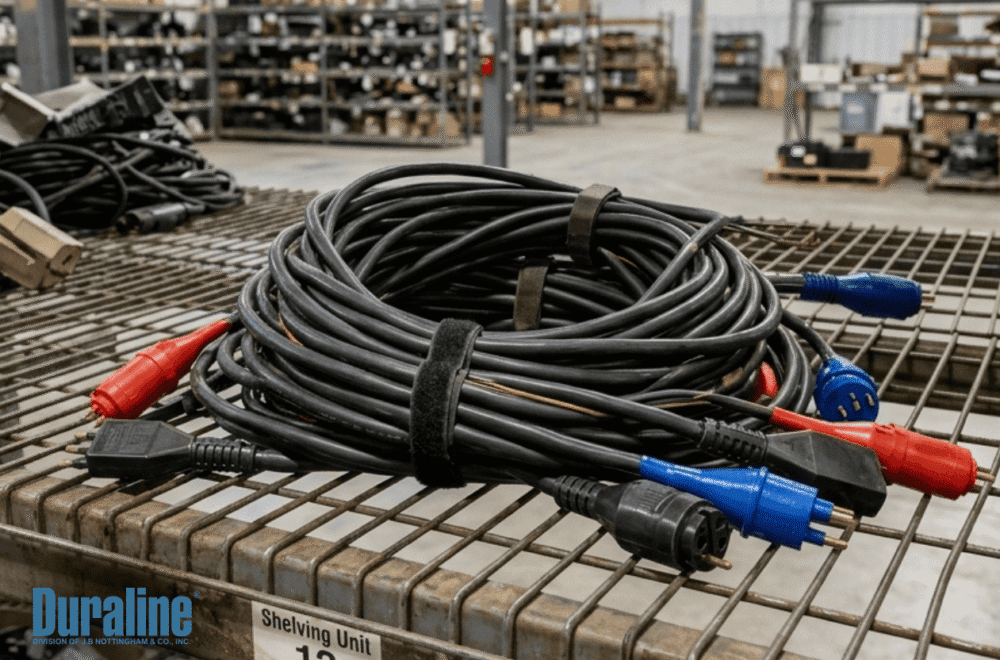
Large contractors may have generators operating at one site, temporary distribution panels at another, lighting deployed at a third, and warehouses filled with cable assemblies accumulated from years of previous projects. When each project develops its temporary electrical system independently, equipment inventories can quickly become a mixture of different connector families, cable lengths, adapters, distribution equipment, and replacement parts.
A better approach is to treat temporary power as a repeatable company-wide system.
By establishing standards for connectors, cable assemblies, distribution panels, lighting, repair components, and common configurations, contractors can create temporary-power packages that move from project to project instead of starting over every time a new job begins.
Why Temporary Power Becomes Difficult to Manage at Scale
Individual purchasing decisions may make perfect sense at the time they’re made.
One superintendent orders cables for a particular generator. Another project needs different distribution equipment. A third crew purchases lighting locally because equipment is needed immediately.
Eventually, the company may own plenty of electrical equipment—but much of it doesn’t work together.
Crews begin carrying adapters simply to connect company-owned equipment to other company-owned equipment. Replacement components multiply. Warehouse employees need to identify several versions of essentially the same cable. Equipment transferred between jobs may arrive only for the receiving crew to discover that it doesn’t match their existing distribution system.
Standardization attempts to solve this problem before equipment reaches the field.
Start With a Small Number of Connector Families
One of the first decisions should be determining which connector families will serve which roles.
There is no reason to force every electrical requirement onto one connector. A high-amperage generator connection has very different requirements from a 20-amp branch circuit.
Instead, contractors can establish a hierarchy.
Cam-Type single-pole connectors can serve appropriate high-current temporary power applications. Duraline’s single-pole range includes E1017, E1022 and E1023 systems, including field-attachable and molded-to-cable configurations for demanding temporary power environments.
NEMA assemblies can then provide familiar connections farther downstream. Duraline currently offers NEMA configurations including 5-15, 5-20, L14-20, L21-20 and others for generator and industrial applications.
Where equipment requires multiple conductors through one connection, Multi-Pin connectors provide another standardized interface.
The objective isn’t having one connector everywhere.
It’s having a defined connector for each level of the temporary-power system.
Standardize the Cable Assemblies Too
Once connector families have been established, cable lengths become the next opportunity.
Without a standard, a warehouse can slowly accumulate 23-foot cables, 37-foot cables, 60-foot cables and countless other configurations originally purchased for individual projects.
Instead, a contractor might establish several preferred lengths appropriate for its typical work.
For example, shorter pigtails could handle equipment interfaces, medium-length assemblies could provide normal distribution runs, and longer extensions could be reserved for situations where power needs to travel substantial distances.
The exact lengths should be determined by the contractor’s work rather than an arbitrary universal standard.
Duraline manufactures products in different lengths and supports custom configurations where standard assemblies don’t satisfy an application. Its NEMA 5-20 products, for example, include heavy-duty 12/3 SOOW extension assemblies, while weatherproof NEMA 5-15 pigtails are available on 14/3 and 12/3 SOOW cable.
Standardizing around a manageable group of lengths makes inventory considerably easier to understand.
Use Pigtails to Create Standard Interfaces
Existing equipment doesn’t always match the standard a contractor wants to establish.
That’s where pigtails become particularly useful.
A generator, machine, panel, or other piece of equipment can require a connection different from the contractor’s preferred temporary-power system. An appropriately designed pigtail can provide the transition between the equipment and that standard.
This approach allows contractors to create a recognizable interface without replacing otherwise serviceable equipment simply because its original connection is different.
The same principle can be applied when new equipment enters the fleet.
Instead of allowing every new machine to introduce another connector family into the warehouse, determine how that equipment will interface with the existing temporary-power standard before it is deployed.
Build Distribution Panels Around the Standard
Connector standardization becomes considerably more valuable when it reaches the distribution equipment.
Duraline designs and manufactures portable power distribution centers custom-built around customer requirements and intended environments. Available configurations can incorporate different outlet sizes and styles while keeping breakers, receptacles, and distribution equipment permanently housed in a reusable panel.
That creates an opportunity for larger contractors.
Instead of having one project fabricate a temporary distribution setup and another build something completely different, a company can establish one or several preferred panel configurations.
Those panels can be designed around the connector families already selected for the company’s cable inventory.
The system begins to fit together intentionally:
Source → Main Cable → Distribution Panel → Branch Cable → Equipment
Rather than:
Source → Adapter → Cable → Adapter → Panel → Different Cable → Another Adapter → Equipment
Portable Panels Can Move With the Project
Standardization becomes especially valuable when equipment is reusable.
Duraline’s portable distribution centers are designed to be transported from location to location by crane or forklift, with removable legs intended to simplify storage and transportation. A single panel can distribute power for heavy equipment, hand tools, and lighting.
That means a contractor can begin thinking of temporary distribution equipment as part of its fleet.
When one project ends, the panel doesn’t belong to that job.
It can be inspected, serviced, inventoried, and moved to the next project.
The same can apply to cable assemblies and lighting.
Over time, temporary power becomes less of a recurring project expense and more of a managed equipment system.
Create Standard Lighting Packages
Temporary lighting is another area where project-by-project purchasing can create unnecessary variation.
A contractor may repeatedly need similar lighting for interior construction, maintenance spaces, tunnels, staging areas, or nighttime work.
Instead of selecting an entirely new system for every project, companies can develop standard lighting packages based on the environments they regularly encounter.
A package might specify the stringer length, fixture spacing, connector configuration, guards, cable type, and quantity required for a typical work area.
Duraline’s heavy-duty temporary lighting provides a useful example. A current 50-foot streamer uses 14/3 SOOW cable, five sockets at 10-foot spacing, a five-foot lead and tail, and NEMA 5-15 connections at each end. Duraline can also custom-design lighting when a standard configuration doesn’t meet the requirement.
Once a configuration works well, additional matching systems can be ordered instead of introducing another variation.
Standardization Makes Warehouse Inventory More Useful
The benefits become particularly visible in the warehouse.
Imagine two companies that each own 100 temporary-power cable assemblies.
The first company’s inventory contains numerous connector families, unusual lengths, several cable sizes, and adapters collected from dozens of past projects.
The second company’s inventory is organized around a handful of established configurations.
Both companies technically own 100 cables.
But the second company’s inventory may be considerably easier to deploy because warehouse personnel know exactly what they have and project managers know what they can request.
A standardized inventory can be organized around recognizable categories such as:
50-ft branch extension — 100-ft branch extension — generator pigtail — distribution feeder — equipment adapter — lighting stringer
The SKU or configuration begins communicating a specific role within the company’s temporary-power system.
Repair Inventory Gets Simpler Too
Standardization also affects maintenance.
If a company operates five unrelated connector systems, it may need replacement contacts, sleeves, caps, tools, and other components for all five.
A more standardized fleet can reduce the number of replacement components maintenance departments need to understand and stock.
Duraline’s single-pole family provides both molded and repair-oriented options. E1022 field-attachable connectors, for example, are available for applications where compatible single-pole equipment needs to be serviced or terminated.
Duraline also offers replacement components and maintenance products across its connector families. Multi-Pin support equipment includes replacement pins, fuses, fuse caps, pin-removal tools, and other service components.
For a large contractor, establishing repair inventory around the same equipment deployed across projects makes those spare parts far more useful.
Crews Become Familiar With the Equipment
Standardization isn’t only a purchasing benefit.
People learn equipment through repetition.
When crews encounter the same connector families, panel layouts, lighting packages, and cable configurations from one project to another, the system becomes familiar.
Employees still require the appropriate training and qualified personnel must perform electrical work, but consistent equipment can reduce the number of unfamiliar configurations workers encounter.
A superintendent transferring from Project A to Project B shouldn’t necessarily have to learn an entirely different temporary-power ecosystem.
The equipment can change in scale while retaining the same underlying logic.
Adapters Become Exceptions Instead of Infrastructure
Adapters will always have an important place in temporary power.
Rental generators may arrive with a different connection. Existing facility infrastructure may use another standard. A customer may provide equipment the contractor has never encountered before.
That’s exactly when adapters are useful.
The problem occurs when the same adapter combination is required every time the company’s own equipment is deployed.
If crews repeatedly connect the same two adapters between the same cable and panel, that is often an indication that a purpose-built cable or pigtail deserves consideration.
Duraline’s custom manufacturing capabilities can support specialized connector combinations, molded assemblies, distribution equipment, and other configurations built around the application.
Standardization doesn’t eliminate adapters.
It makes them solutions to unusual circumstances instead of permanent parts of normal setup.
Custom Equipment Can Actually Improve Standardization
“Custom” and “standardized” may sound like opposites.
For a large organization, they can work together extremely well.
A contractor may develop a custom cable assembly specifically because no standard catalog product matches the connection it wants to establish across its fleet.
Once that configuration has been engineered and proven in the field, it can become that contractor’s standard.
The same principle applies to distribution panels, pigtails, spiders, connector combinations, and lighting packages.
Duraline manufactures custom portable panels and other purpose-built electrical products, while its standard product pages repeatedly note its ability to develop custom configurations for both shorter and longer production runs.
The first order solves the engineering problem.
Future orders build the fleet.
Retain Proven Configurations for Future Buildouts
This is particularly important when a contractor expects to expand.
Once Duraline and the customer establish a successful configuration, the established design can be retained as a reference for future production, rather than forcing the customer to recreate the requirements every time another project needs equipment.
That reference might include details such as cable type, length, conductor size, connector combination, molding configuration, color identification, panel layout, receptacle arrangement, or lighting configuration.
The next project can then begin with:
“Build us more of our established configuration.”
Instead of:
“Here are several pieces of equipment from the warehouse. Can we figure out what we ordered three years ago?”
That becomes especially useful for contractors with recurring projects, multiple regional operations, or standardized project types.
Standardize the System, Not Every Jobsite
No two construction projects are exactly alike.
One may need considerably more generator capacity. Another may require extensive temporary lighting. A third may have unusual equipment that requires specialized connections.
Standardization shouldn’t prevent a project from adapting to those requirements.
The better approach is creating standard building blocks.
A larger project gets more building blocks.
A smaller project gets fewer.
A specialized project receives the appropriate custom additions.
But the underlying connector families, cable assemblies, panels, lighting systems, and maintenance strategy remain familiar.
Think in Temporary-Power Packages
For contractors managing multiple projects, it can be useful to stop thinking exclusively in individual products and start thinking in packages.
A standardized project package could include:
- Main feeder assemblies and generator connections
- Portable distribution panels
- Branch-circuit extensions and pigtails
- Appropriate Multi-Pin or specialty equipment connections
- Temporary lighting packages
- Common adapters
- Caps and protective accessories
- Replacement connector and repair inventory
The exact package can then be scaled according to project size.
This also gives procurement teams a more predictable framework for planning future equipment purchases.
From Project Expense to Reusable Infrastructure
Temporary power may only remain at a particular site for months, but the equipment itself can serve project after project.
That’s the larger advantage of standardization.
A cable purchased for Project A can become useful on Project B because both follow the same connection strategy. A distribution panel can move to Project C because the incoming and outgoing connections match the company’s existing inventory. Lighting from Project D can supplement Project E without requiring an entirely different electrical setup.
Duraline’s portable distribution equipment is specifically designed around this reuse philosophy, with permanent breakers, receptacles, and distribution housed in transportable equipment intended to be used from job to job.
The more compatible the fleet becomes, the easier it is to treat temporary power as reusable company infrastructure rather than disposable project material.
Build a Temporary-Power Standard Around the Way Your Company Works
There isn’t one universal temporary-power standard appropriate for every contractor.
The right system depends on the generators you operate, the equipment your crews use, typical project size, cable distances, voltages, environmental conditions, and industries you serve.
The goal is to identify those recurring requirements and build a repeatable system around them.
Duraline can support that process with NEMA assemblies, Cam-Type single-pole connectors, Multi-Pin systems, molded pigtails and extensions, custom portable distribution panels, temporary lighting, repair components, and purpose-built assemblies manufactured around specific applications.
Explore Duraline Industrial Power, Lighting and Distribution Products
Contact the Duraline sales team at 386-873-2990 to discuss the equipment currently moving between your projects. We can help identify opportunities to establish common connector families, cable configurations, distribution equipment, and lighting packages—and create repeatable custom configurations that make future buildouts easier to specify.