
SOOW vs. SJOOW Cable: Which Should You Use for Industrial Power?
Choosing an industrial power cable isn’t simply a matter of selecting the correct wire gauge. Voltage, environmental exposure, flexibility, oil resistance, and the equipment being powered all influence which portable cord is appropriate for an application.
Two designations you’ll frequently encounter are SOOW and SJOOW. The names look almost identical—and the cables share several important characteristics—but one letter represents a major difference in their electrical ratings.
Understanding that difference can help engineers, contractors, maintenance personnel, and purchasing teams select the right cable before choosing the connectors and equipment that will be attached to it.
What Is SOOW Cable?
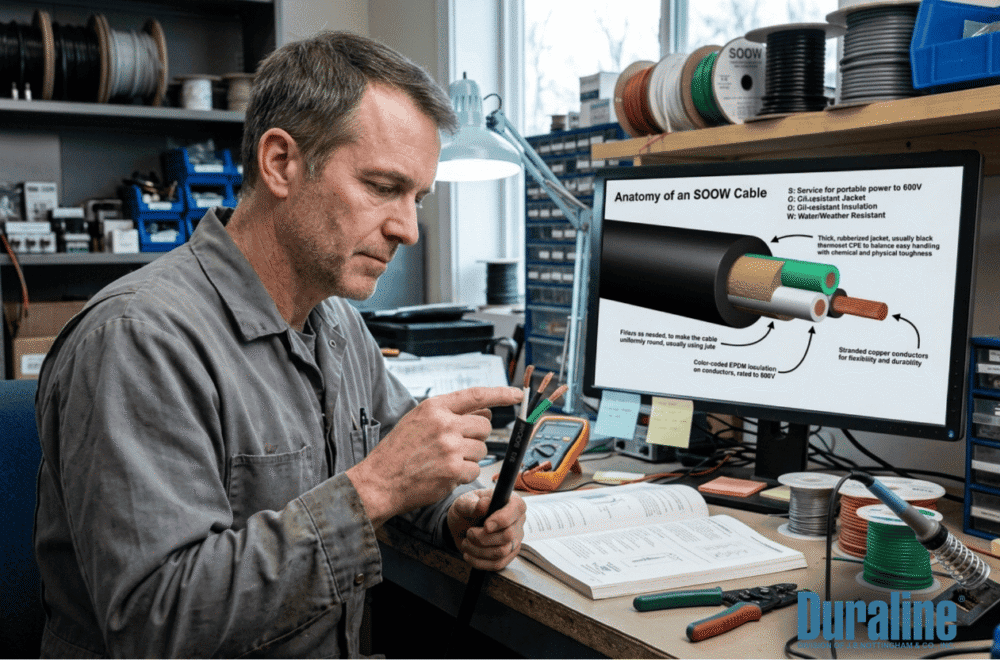
SOOW portable cord is a flexible service cord designed for demanding portable-power applications.
The letters in SOOW describe several of the cord’s characteristics:
S — Service cord
OO — Oil-resistant insulation and oil-resistant outer jacket
W — Weather resistant
SOOW is commonly rated for 600-volt service and is considered an extra-hard-usage portable cord. Its combination of flexibility and environmental resistance makes it useful for industrial equipment, temporary power, construction, mining, and other applications where cable may encounter frequent movement or demanding working conditions.
This heavy-duty construction is one reason SOOW cable appears throughout Duraline’s temporary power and lighting product families.
What Is SJOOW Cable?
SJOOW portable cord belongs to the same general family of flexible portable cords.
Its designation is very similar:
S — Service cord
J — Junior service
OO — Oil-resistant insulation and oil-resistant outer jacket
W — Weather resistant
That “J” is the critical difference.
SJOOW is a junior-service cord generally rated for 300 volts, compared with the 600-volt rating commonly associated with SOOW. Like SOOW, it provides oil and weather resistance and is designed for flexible applications.
This can make SJOOW a practical choice when the application doesn’t require the higher voltage rating of SOOW.
SOOW vs. SJOOW: What’s the Main Difference?
For someone comparing the two cables, the easiest distinction to remember is:
| SOOW | SJOOW | |
|---|---|---|
| Service type | Extra-hard service | Junior service |
| Typical voltage rating | 600V | 300V |
| Oil-resistant insulation | Yes | Yes |
| Oil-resistant jacket | Yes | Yes |
| Weather resistant | Yes | Yes |
| Flexible portable cord | Yes | Yes |
The difference does not mean that SJOOW is simply a “bad” or inferior version of SOOW. They are intended for different electrical requirements.
If an application requires 600-volt-rated portable cord, SOOW is the appropriate direction of the two. When the application operates within the ratings of SJOOW, the junior-service cable may provide the flexibility and environmental resistance required without specifying a heavier cable than the application needs.
The final cable selection should always be based on the equipment, load, voltage, conductor size, environment, applicable codes, and requirements of the installation.
Where Is SOOW Cable Commonly Used?
The heavier service rating of SOOW makes it particularly useful in demanding industrial and temporary-power environments.
Portable service cord in this category is commonly encountered around construction sites, mines, mills, machinery, marinas, industrial facilities, and other locations where flexible electrical connections must withstand challenging conditions.
At Duraline, SOOW cable is used extensively throughout our temporary lighting products. Our temporary lighting systems are molded to heavy-duty 600-volt SOOW cable and are used in applications including shipyards, cruise ships, construction sites, carnivals, tents, tunnels, bridges, mines, and highway construction projects.
That makes SOOW particularly valuable when a cable assembly must combine electrical capacity with flexibility and durability.
SOOW Cable and Temporary Industrial Lighting
Temporary lighting provides an excellent example of why cable selection matters.
A lighting stringer may be repeatedly installed, removed, coiled, transported, and deployed again. On an industrial site, the cable can also encounter rough surfaces, dirt, moisture, oils, and demanding environmental conditions.
Duraline’s LED Temporary Lighting Stringers, for example, use 600-volt SOOW cable with sockets integrally molded directly to the cable. The assemblies incorporate rubber-molded sockets, sealing features, guards, and other components designed around industrial temporary lighting applications.
Explore Duraline Temporary Lighting Systems
SOOW is also used with Duraline’s Wide Area LED Lighting Systems, including configurations featuring weatherproof NEMA 5-15 connections for portable outdoor and wet-location lighting.
Where Is SJOOW Cable Commonly Used?
SJOOW fills a similar role where the application does not require the 600-volt service rating of SOOW.
Its flexibility, oil resistance, and weather resistance make this type of portable cord useful around portable equipment, machinery, entertainment systems, stage equipment, industrial equipment, and custom extension assemblies operating within its electrical ratings.
Entertainment and event applications are particularly relevant because equipment frequently needs to be installed, moved, disconnected, transported, and installed again.
That’s also an area where Duraline uses both SJOOW and SOOW.
SJOOW, SOOW and Stage Pin Connectors
Duraline’s Weatherproof 3-Wire Stage Pin Connectors provide a good example of a product family that can incorporate either cable type.
Duraline offers 20- and 60-amp Weatherproof Stage Pin Connectors that can be integrally molded to SJOOW or SOOW cable in solid rubber. The product family is designed for applications such as temporary event power, lighting, stage systems, and related equipment.
Explore Duraline Weatherproof 3-Wire Stage Pin Connectors
This is a good demonstration of why the connector alone doesn’t determine the complete electrical assembly. The cable type, conductor size, voltage requirements, connector configuration, and application all need to be considered together.
SOOW Cable and NEMA Connectors
SOOW also appears throughout Duraline’s Industrial and Commercial Grade NEMA connector assemblies.
For example, Duraline offers Weatherproof NEMA 5-15 configurations on 14/3 or 12/3 SOOW 600-volt cable, while L14-20 assemblies can be supplied on heavy-duty 12/4 SOOW cable. Higher-conductor-count configurations include L21-20 and L21-30 assemblies using 10/5 SOOW 600-volt cable.
Explore Duraline NEMA Plugs, Connectors and Receptacles
These combinations allow familiar NEMA configurations to be incorporated into rugged cable assemblies for construction, industrial, generator, maintenance, temporary power, and related applications.
Cable Is Only One Part of the Assembly
When specifying portable power equipment, it’s easy to focus exclusively on the connector. But a heavy-duty connector attached to an inappropriate cable doesn’t create the right assembly.
The cable, connector, molding, conductor size, voltage rating, environmental requirements, and intended application should be considered together.
That’s why Duraline’s product range includes complete molded and assembled solutions rather than simply individual electrical components. Products can combine SOOW or SJOOW cable with NEMA devices, stage pin connectors, lighting fixtures, spiders, distribution equipment, and other connection systems depending on the application. Duraline’s molded spider assemblies, for example, can incorporate Duraline or NEMA-type plugs and connectors on heavy-duty cable.
For customers, this provides an opportunity to specify the complete assembly around how it will actually be used in the field.
Which Cable Should You Choose?
The answer comes down to the requirements of the application.
If you’re building a demanding industrial power or lighting assembly that requires a 600-volt-rated portable service cord, SOOW is generally the appropriate choice between these two cable families.
If your application falls within a 300-volt junior-service rating, SJOOW may provide the oil resistance, weather resistance, and flexibility required without specifying SOOW unnecessarily.
But voltage is only the beginning. Amperage, conductor count, wire gauge, cable length, voltage drop, environment, connector type, equipment requirements, and applicable electrical codes should all be considered before specifying an assembly.
The best cable isn’t necessarily the biggest or heaviest one. It’s the cable properly matched to the electrical and physical requirements of the job.
Build the Right Cable Assembly with Duraline
Whether your application requires SOOW, SJOOW, NEMA connectors, weatherproof stage pin connections, temporary lighting, spiders, or custom power distribution equipment, Duraline can help determine the right combination for your application.
Rather than selecting the cable and connector independently, our team can help you evaluate the complete assembly—including conductor size, cable length, connector configuration, environmental exposure, and how the equipment will actually be used.
Contact the Duraline sales team at 386-873-2990 to discuss your requirements and build an industrial cable assembly designed around your application.